
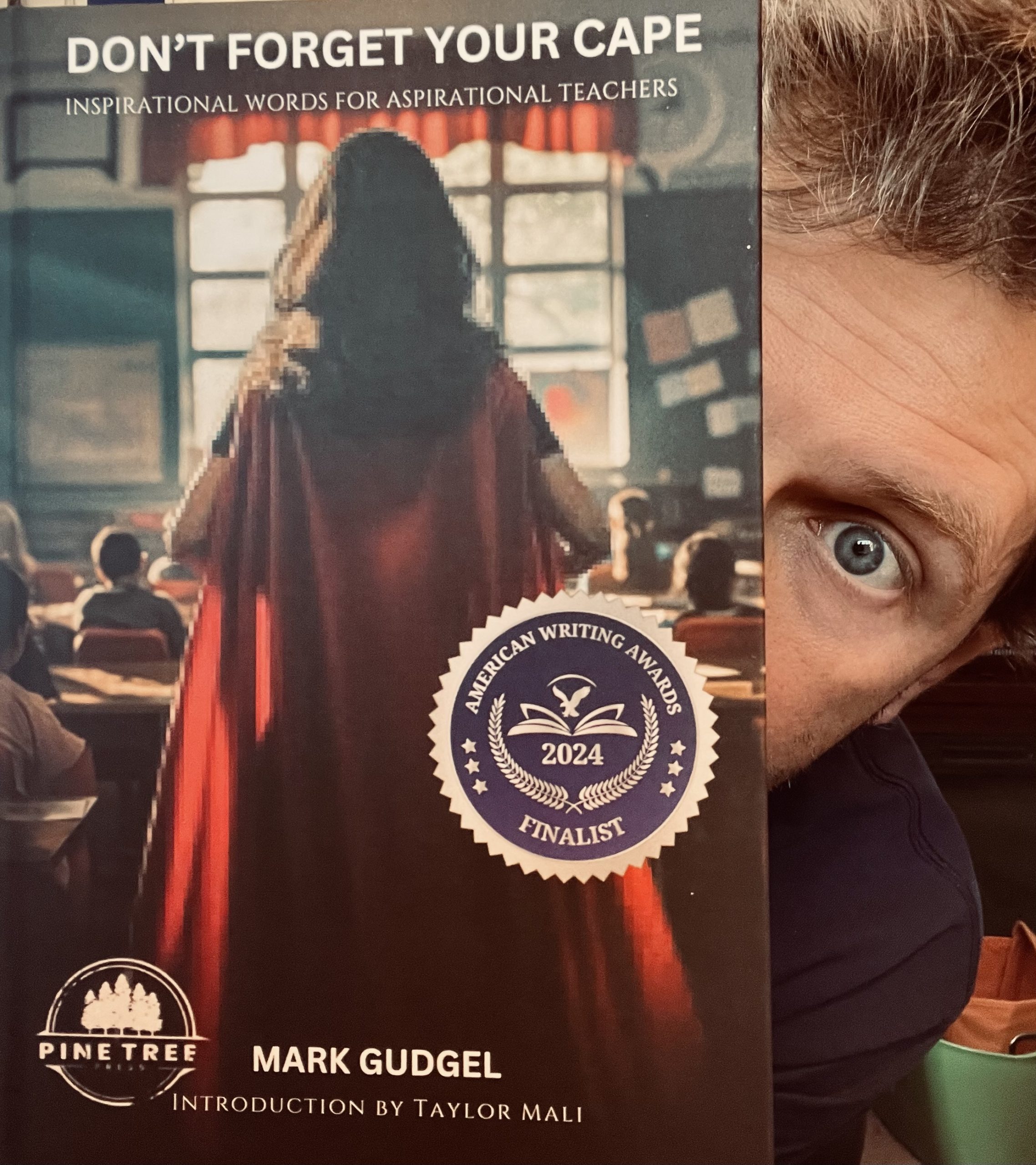
My latest book is all about teaching and why teachers are the heroes our children both need and deserve.
Don’t Forget Your Cape!
A few years back, maybe less—time periods blend ever seamlessly the more of them that pass me by—I was supervising student teachers at both College of Saint Mary and Nebraska Wesleyan University. I loved it. Getting to watch energetic, aspiring teachers refine their craft was a dream come true, though from time to time I wondered what if anything I had to contribute to their journey.
It became my habit to send them weekly emails on Monday morning, little pep-talks reminding them that it was ok to make mistakes and that the job of teaching is a noble pursuit. I often shared my own experiences with them, and did my best to be encouraging. To be honest, I wasn’t sure if they were even reading them until the day I forgot to send one. When more than half of them emailed to say “Hey, where’s my pep-talk?!” I realized maybe I had something to contribute after all.
When the semester ended I refined the emails into essays and, to my surprise, several publishers expressed interest. I chose one, and today those essays are collected in a book entitled Don’t Forget Your Cape: Inspirational words for aspirational teachers, from Pine Tree Press.
Below is an excerpt from one of the chapters. It doesn’t make me look good, and it’s not supposed to. Much of what I write about and say to teachers has to do with the ubiquitous mistakes of my teaching career. By the end I may well have been a truly excellent teacher, but I was never perfect, and at times I was downright awful. This section illustrates one of those times, an opportunity missed, and something that I and others can hopefully learn from.
As teachers, we learn and grow. You probably haven’t been a teacher for very long if you don’t have a whole raft of anecdotes about times when you wish you had done something differently. Early in my career, and way before I came to the conclusion that context mattered more than content in the classroom, I was sitting in the IEP conference room at the high school where I taught, entirely exasperated by the conversation I was having.
“He spontaneously breaks into song,” I huffed at the defensive parent of a young man who was, among so many other wonderful things, autistic. She did not appear surprised, nor did she deign to respond to my complaint.
“In the middle of a lesson,” I persisted, as if this added context might help her understand.
“Mmmm-hmm,” she responded, coolly staring me down with her arms crossed across her chest.
“It is ex-treme-ly dis-rup-tive!” I stated, eyes wide, Snapeishly emphasizing every syllable as if I was attempting to explain nuclear physics to a Pez dispenser.
My student’s mother looked quizzically at me from her chair. No doubt, the young man also sang at home. No doubt, she’d felt exasperated at times herself. No doubt, she had heard this all before. No doubt, she’d tried everything to help her son, including meeting with arrogant, impatient, inexperienced young teachers who wanted to silence her son more than they wanted to hear what he had to say. At last, she raised her eyebrows and said simply “Maybe you should let him sing.”
In my early twenties, married to my content and convinced that any child who did not fully master the nuances of writing a good thesis statement was destined to wind up as a homeless crackhead, I couldn’t even hear her. Nobody was singing in my classroom unless I was the conductor. The young man transferred out of my class at the semester. I can only hope it was into the classroom of one of my veteran colleagues who was able to provide him with the understanding, space, and environment that he needed, someone who could succeed where I had failed.
Thinking back on it years later, a better teacher than I was then could have really capitalized on that situation, not only to help the young man live his best life, learn new things, and enjoy his schooling, but also to the benefit of every other student in the room. There was an opportunity to teach empathy and, hell, to learn it for myself, but I didn’t recognize it, and thus I couldn’t seize it. In my reveries, I sometimes torture myself with thoughts of how much fun it could have been to establish, when the moment called for it, an impromptu choir in that freshmen English class. The band kids could have broken out their instruments. We could have had set lists, even written original songs. I could have been the number one fan of a wicked rock band with an autistic front man, instead of the reason it never happened. There was an opportunity there not only to have a great deal of fun and teach important life lessons, but also to truly be the hero that teachers are called to be—but I missed that chance. I only hope that his next teacher did not. I wish that I had let him sing.
Despite largely being written about blunders and miscalculations that haunt me to this very day, I was humbled by the extraordinary reviews the book got and honored by its nomination and subsequent status as a finalist for the American Writing Awards. When one of my teacher heroes wrote “Game recognizes game. Welcome to the Gudgel Show,” I got chills. When an author I admire wrote “If Mark Gudgel had been my mentor while teaching, I would likely still be in the classroom,” I was deeply gratified. And when a close teacher friend responded by saying my book “…reminds us that goodness should always be at the center of everyone’s pedagogy,” I may have choked up a little bit. In the book, I quote John Oliver as saying “Teachers are superheroes who should make a million dollars a year,” though in reality that might be the least humorous thing the comedian ever said. He meant it seriously, and so do I. Not being a classroom teacher anymore pains me at times, but I derive continued purpose from supporting teachers whenever and however I can.
On a Zoom call with a friend in California today, I was informed that the local bookstore was struggling to acquire my book. I’d always prefer you buy my books at local bookstores, though you can also email me and I can send you a copy. Of course, it’s available at Barnes & Noble and at Amazon as well. I’m sharing the Amazon link below, and if you buy it there please leave a kind review.
If you know of a school district looking to bring someone in to share encouragement with staff at the start of the next school year, please send them my way. Nothing would make me happier than to remind teachers anywhere—everywhere—of just how vital to the world they truly are. As ever, thanks for reading and for keeping in touch. Have a terrific day.
Sincerely,
Mark